The steady growth of China’s foreign trade has been further consolidated.
According to data released by the General Administration of Customs on August 7, in the first seven months, China’s total import and export value was 21.34 trillion yuan, a year-on-year increase of 24.5% and an increase of 22.3% over the same period in 2019. Among them, the export was 11.66 trillion yuan, a year-on-year increase of 24.5%; Imports were 9.68 trillion yuan, a year-on-year increase of 24.4%.
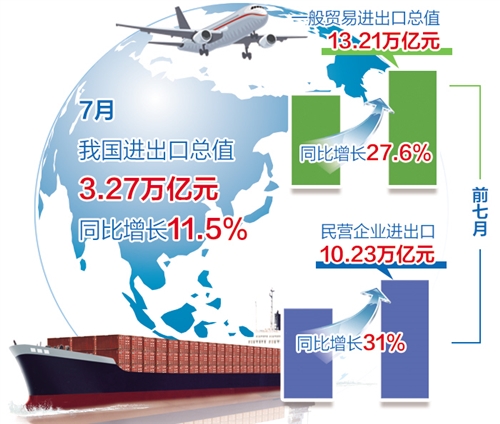
"In July, China’s foreign trade continued to maintain a good development trend, and the total value of imports and exports achieved positive growth year-on-year for the 14th consecutive month." Li Kuiwen, director of the Statistics and Analysis Department of the General Administration of Customs, said that in July, China’s total import and export value was 3.27 trillion yuan, an increase of 11.5% year-on-year and an increase of 18.8% over the same period in 2019.
Under the combined effect of multiple factors such as global supply and demand, China’s foreign trade has achieved sustained and rapid growth this year. On the one hand, with the gradual recovery of the global economy, the demand for international trade has been boosted, which has formed a strong support for China’s exports; On the other hand, the sustained and stable recovery of China’s economy has also driven the rapid growth of imports. Overall, the steady growth of China’s foreign trade has been further consolidated.
The data shows that the import and export growth rate of private enterprises in China is the fastest, and the proportion has further increased. In the first seven months, the import and export of private enterprises was 10.23 trillion yuan, a year-on-year increase of 31%, accounting for 47.9% of China’s total foreign trade value, an increase of 2.4 percentage points over the same period last year. In terms of trading partners, China’s imports and exports to ASEAN, the European Union, the United States and Japan were 3.12 trillion yuan, 2.96 trillion yuan, 2.62 trillion yuan and 1.37 trillion yuan, up 24.6%, 23.4%, 28.9% and 12.6% respectively. Among them, ASEAN is China’s largest trading partner, accounting for 14.6% of China’s total foreign trade.
From the perspective of product structure, exports of mechanical and electrical products and labor-intensive products both increased. Among them, the export of mechanical and electrical products increased by 25.5%, accounting for 59% of the total export value. Automatic data processing equipment and its parts, mobile phones, automobiles and other products have a good market performance.
It is noteworthy that in the first seven months, the total import and export value of China’s general trade reached 13.21 trillion yuan, up 27.6% year-on-year. The proportion of trade increased by 1.5 percentage points compared with the same period of last year, while the proportion of processing trade decreased by 2 percentage points.
On the import side, the import of bulk commodities is mixed in quantity and price. Among them, the import price of iron ore, crude oil, coal and other commodities decreased, the import price of natural gas increased and fell, and the import price of soybeans rose.
From the market analysis, the recovery of external demand and the stable domestic economy are expected to continue to provide strong support for the steady growth of foreign trade. According to a recent survey by the Ministry of Commerce, about 40% of foreign trade enterprises’ new export orders increased year-on-year.
"However, with the gradual increase of the base in the same period last year, the growth rate of foreign trade will fall back in the second half of the year, and the future development of foreign trade will still face many uncertain and unstable factors." According to Li Kuiwen’s analysis, the current ups and downs of the global epidemic and the slow recovery of the world economy, coupled with high raw material prices and poor shipping logistics, have squeezed the profit margins of foreign trade enterprises, and at the same time have affected the willingness of enterprises to take orders.
In view of the unfavorable factors such as exchange rate fluctuations and increased labor costs that may occur in the second half of the year, Li Xinggan, director of the Foreign Trade Department of the Ministry of Commerce, said that the Ministry of Commerce will further improve the trade policy toolbox, optimize the business environment, reduce the cost of enterprises, and support various market entities, especially small and medium-sized foreign trade enterprises, to stabilize production.
"While doing a good job in policy reserves, China’s high-level open platform construction will also help the steady growth of foreign trade." Yang Changyong, a researcher at the Institute of Foreign Economics of China Macroeconomic Research Institute, said that in recent years, the construction of open platforms such as the Pilot Free Trade Zone, the Hainan Free Trade Port, the Comprehensive Bonded Zone and the Cross-border E-commerce Comprehensive Experimental Zone has been maturing, which will help foreign trade enterprises to make better use of the two markets and resources and promote the smooth connection of domestic and international dual cycles.
Li Kuiwen said that the recently released "14 th Five-Year Plan for Customs Development" proposed that the promotion of high-quality development of foreign trade must be placed in a more prominent position. In the next step, we will continue to give full play to our own functional advantages, improve the efficiency and level of domestic large-scale circulation with international circulation, and promote the formation of new advantages for China to participate in international economic cooperation and competition.