The Last Warrior in the 150 Years of Meiji Restoration —— The whole story of the Southwest War in Japan
Since the Sino-Japanese War of 1894-1895, China’s expression of Meiji Restoration in Japan has focused on its measures and achievements, that is, how Japan became one of the great powers through top-down reform. In fact, the Meiji Restoration, like many great changes in history, touched the cake of some old interest classes and eventually ended in civil war. With Japanese characteristics, both sides of the civil war declared their allegiance to Emperor Meiji and fought side by side. The twists and turns should be discussed from the early years of Meiji.
The gap is beginning to appear: from "returning the version of the book" to "equality of the four people"
In 1869, the Tokugawa shogunate was defeated by the reformists headed by Samoan (southwest of Kyushu) and Changzhou (west of Honshu), and the state power belonged to Emperor Meiji. Because of his young age, the power was actually in the hands of the reformers. The three most important figures were Saigō Takamori and Ōkubo Toshimichi, who were born in Samoan, and Kido Takayoshi, who was born in Changzhou, also known as the "three reformers".

Kido Takayoshi, Saigō Takamori, and Ōkubo Toshimichi: Three Outstanding Japanese Reformers.
In the war with the shogunate, the reformists made many compromises and temporarily tolerated their separatist side. When the war subsided, Kido Takayoshi, eager to carry out the reform, was determined to take over the power first, and urged the "version of the book to be returned" and forced the vassals to hand over the land and population to the central government.
At first, Saigō Takamori and Ōkubo Toshimichi both had reservations about Kido Takayoshi’s decision, but there were subtle differences in their attitudes. Saigō Takamori believes that samurai must be the backbone of Japan as they have been for hundreds of years, and the promotion of centralization should be based on the premise of ensuring that samurai do not change color. Ōkubo Toshimichi was in favor of civilian administration, worried that the abolition of governors would lead to local chaos, and hoped that it would be done slowly.
Thanks to the efforts of Saigō Takamori and others, all the Japanese vassals surrendered their land and population, and the central government also took the opportunity to set up "Imperial Family Soldiers" and "Zhentai" (the predecessors of various Japanese divisions later), which not only absorbed many lower-level warriors to join the army, but also strengthened the strength of the central government. Most of the samurai failed to get jobs in the army, and the Meiji government specially promulgated a "salary system" for them. The central government paid the salaries of the samurai who were in charge of the vassals in the past (but it dropped by about half) to prevent them from being poor.

Paintings showing Japanese governors handing over land and population to the central government.
The world did not expect that this was the last time that Saigō Takamori and Ōkubo Toshimichi, two fellow villagers and friends, worked together on major national policies-both of them were patriots, but the "country" in their eyes was different-Japanese and samurai in Xixiang were one; Japanese in Okubo can live without samurai.
In 1870, the Meiji government initiated the household registration reform, renamed "samurai" as "gentry", declared that "the gentry, agriculture, industry and commerce are equal", and allowed the gentry to farm, work and do business, and also allowed people from civilian backgrounds to be officials. Because of the pressure of life, many gentry who were smashed by the government became tenant farmers, artisans and even rickshaws, while the children of farmers and merchants who used to be beheaded when crossing the samurai queue took official positions and took charge of the old masters.
Saigō Takamori and Ōkubo Toshimichi are very dissatisfied with this situation. Xixiang, who served as a field marshal, deeply felt that "the equality of the four people" was to kill the cremation, leaving his monthly salary of 500 yen only 15 yen necessary to maintain his life, leaving the rest in his living room and letting the impoverished cremation take it for themselves; At that time, Okubo, the then Minister of Finance, saw that the income of the imperial court was already stretched, and he was eaten by hundreds of thousands of cremation families for nothing every year. He was also full of grievances and struggled for solutions.

Saigō Takamori, dressed as a field marshal, actually doesn’t like western-style clothes himself.
The intensification of contradictions: the theory of opening eyes to the world VS recruiting Korea
In 1871, the Japanese government sent Iwakura Tomomi to lead an envoy to Europe and America, with the main purpose of negotiating with the great powers, hoping that countries would forgive the unequal treaties signed with Japan. Another task of the mission is to inspect the national conditions of the great powers as a reference for the reform, so many high-level officials also visited with the mission, and Ōkubo Toshimichi, who is in charge of the government purse, is one of them.
In the 19th century, countries completely adhered to the law of the jungle, and Iwakura envoys kept hitting a wall. No western power was willing to forgive the unequal treaties with Japan. Ōkubo Toshimichi, as an assistant envoy, was gradually fascinated by the prosperity of European and American countries: in the United States, the emerging modern education radiated endless technological innovations and indomitable struggle passion to the New World; In Britain, the "world factory" supports the unprecedented strength and confidence of the empire that never sets; In Germany, Bismarck, the "iron-blooded prime minister", personally taught the oriental visitors the diplomatic secret of "might is right". The experiences of the above three countries became important references for the popularization of education, the development of industry and the expansion of military force in Meiji Japan.
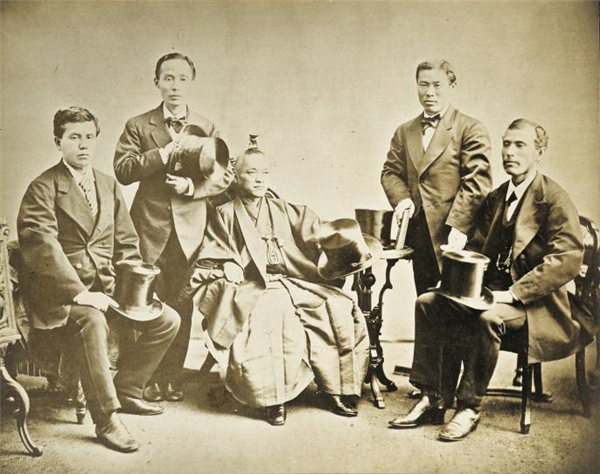
The main figures of Iwakura’s envoy took a group photo. The one with the hat on the far right on his knee is Ōkubo Toshimichi, who is used to wearing a suit.
The Iwakura mission originally planned to visit for half a year, but it actually took nearly two years. When it returned to Japan in 1873, the members of the mission, who had different origins and positions, condensed into a new political group, also known as the "returnees". After opening their eyes to the world, they fully realized how weak Japan’s national strength is and how dangerous the world controlled by whites is, and advocated taking Europe and the United States as teachers and carrying out comprehensive reforms without delay.
Saigō Takamori presided over the cabinet during the visit of Iwakura’s envoy. He didn’t feel the strong breeze of the west wind, but he focused on the Korean kingdom, which belongs to the traditional eastern countries.
It turned out that as soon as Saigō Takamori came to power, he was overwhelmed by the huge debts inherited by the Meiji government from the governors and the huge expenses for supporting the cremation. He planned to follow the old trick of Toyotomi Hideyoshi 300 years ago, send troops to invade the Korean peninsula across the sea, plunder land and wealth to solve the financial crisis, which is known as "the theory of levying Korea". Saigō Takamori also creatively proposed "suicide provocation", that is, he visited North Korea himself, made rude behavior, and induced North Koreans to kill himself, so as to gain an excuse for going to war.

Siméon-François Berneux, a French missionary, was executed in 1866 by the closed-door policy of the Li Dynasty in North Korea, which led the French fleet to attack North Korea, which may have inspired Saigō Takamori.
When Iwakura’s diplomatic mission, which was still overseas, heard that the "theory of levying Korea" was about to be implemented, it immediately caused an uproar and hurried back to Japan, resolutely opposing war with North Korea, headed by Ōkubo Toshimichi. Saigō Takamori, on the other hand, accused the envoys of spending a lot of money, but didn’t reduce any unequal treaties, and still dared to add up their sleeves, which was simply a stubborn bark.
In this way, the contradiction between the returnees and those who recruited Korea suddenly broke out. In essence, this is the contradiction between reform and conservatism, development and internal friction: the returnees believe that reform and development can finally solve Japan’s predicament, and if they invade North Korea at present, it is not so much expansion as "poverty"; On the other hand, the Korea-recruiting faction did not jump out of the thinking limitations of Japanese samurai, and used to solve the immediate crisis with knives and guns, but did not realize that the force of western powers far exceeded that of Japan, and taking risks on its own might make the whole country miss the once-in-a-lifetime opportunity for change.
Saigō Takamori privately approached Ōkubo Toshimichi, hoping that he would support him, but Okubo said that domestic reform could not be delayed any longer, and when Japan became stronger after the reform, it would naturally expand abroad. Okubo’s answer was mostly out of consideration for the country, without any consideration for Xixiang’s plan to help the increasingly poor cremation. Since then, the two have completely broken up.
Private negotiations failed, and the returnees and the Korean-levying factions had a short and fierce infighting. Saigō Takamori, wearing a kimono, lambasted Ōkubo Toshimichi, wearing a suit, as "the first coward of Satsuma" at the cabinet meeting. The latter didn’t answer back, but handed it over to the adult Meiji Emperor through Iwakura Tomomi, stating that it was impossible to levy Korea. At the same time, he hinted that once the "levy of Korea" was successful, Field Marshal Saigō Takamori would be highly rewarded, and he would become the new shogunate general and put the emperor on the air again.

Japanese painting "Discussion Map of Korea"
Soon, Emperor Meiji issued a letter demanding that domestic reform be the top priority, and that the "Korean conquest" be postponed indefinitely.
The Korea-recruiting faction was like a blow to the head. More than 600 officials under Saigō Takamori resigned in anger, and the returning faction completely grasped the Japanese regime. At this time, it was October 1873, and frustrated Korean officials returned to their hometowns one after another, like a fiery kindling, while the cremation, which was increasingly embarrassed everywhere, was a ready-made powder keg.
Towards civil war: samurai rebellion, private schools and the abolition of knives
The officials who resigned from the Korea-recruiting faction were mainly the gentry. Since they could not invade North Korea, the Meiji government, where traitors were in power, was their enemy. In Saga Prefecture, Jiang Teng Xinping first raised the anti-flag, and in January 1874, more than 3,000 bankrupt gentry gathered to rob banks and rose up to revolt. Ōkubo Toshimichi, then Minister of the Interior (equivalent to the later Prime Minister), ordered the crackdown by thunder and mobilized three towns and Taiwan (divisions) to make an all-out encirclement and suppression. When the army was under siege, the rebellious Saga cremation surrendered to the loyalist one after another. In an instant, Jiang Teng Xinping became a loner and was arrested and executed.

Japanese painting reflecting the riot in Xinping, Edo.
As one of the veterans of the Japanese army, Saigō Takamori knew the power of the modern army very well, so he wouldn’t rashly do the stupid thing of rebellion. He opened a "private school" in his hometown of Kagoshima County, but the lean soldier of the military for half his life was not so much a "principal" as a "commander"-his school never taught arithmetic composition and painting music, but taught him to shoot and shoot every day and practice marching array every day! Moreover, the "students" recruited by Guangkai Branch are all local gentry who hate the government, and middle and lower-level officials in Kagoshima Prefecture have also worked as part-time cadres in private schools in Saigō Takamori, creating a country within a country.
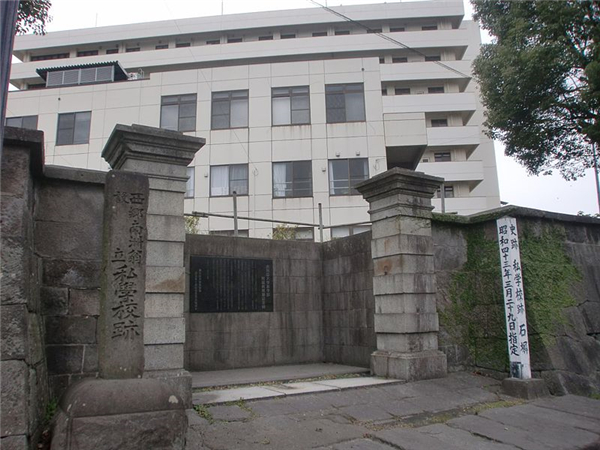
The main entrance site of Saigō Takamori private school has been preserved to this day.
In 1876, the reform of the Meiji government took another drastic measure, not only changing the salaries of the gentry into bonds instead of cash, but also promulgating the Order of Abolishing Knives, announcing that no one except active servicemen and policemen should wear swords, thus ending the centuries-old privilege of samurai wearing swords in one fell swoop. In the eyes of the gentry, the Meiji government’s reform was indeed at all costs, and it was itself that "cost".
As a result, the angry cremation began to launch rebellion all over Japan. In the "Kamikaze Rebellion" in Kumamoto Prefecture, more than 170 rebellious cremation raided the kumamoto castle garrison, chopped and killed Major General Masaaki Nongtian, the garrison chief who was whoring, and killed more than 270 loyalists before being suppressed.

Japanese painting reflecting the chaos of the divine wind
Ōkubo Toshimichi showed no mercy to the cremation rebellion, and implemented an iron fist policy, and all leaders, big and small, were executed. The reason why he didn’t dare to forgive the rebels was that Kagoshima Prefecture, which gathered the most hardcore cremation and stored a large number of guns and ammunition, kept a strange calm for the time being, and more because Saigō Takamori, the soul of the cremation, showed abnormal indifference to the Scrap Knife Order.
Saigō Takamori was biding his time. He publicly reprimanded the "students" who were eager to launch the rebellion in private schools, but in a private letter with the rebel leaders in other places, he said that he wanted to "make a blockbuster without making a sound".
Many senior officials in the Meiji government have long disliked Saigō Takamori’s manner as an uncrowned king of Kyushu. While planning to transport the arms and materials of Kyushu, they also sent special agents to spy on Saigō Takamori. Unexpectedly, these two things became the fuse of the civil war.
At the end of January, 1877, the government secretly sent a boat to Kagoshima County to carry weapons and equipment, but word got out. Immediately, a large number of gentry rushed out of Xixiang private school, looted arsenals in Kagoshima County, kidnapped and tortured spies who were monitoring Saigō Takamori, and got the confession that "the government was going to assassinate Saigō Takamori and bloodbath the private school".
On February 6th, 1877, the indignant students in private schools demanded to start fighting at once. Saigō Takamori had no choice but to obey the "public opinion" and set up the "Samoben Camp" in private schools, shouting "New Deal and Virtue", claiming to go to Tokyo to be the "Qing Jun side" of Meiji Emperor and rebuild the country belonging to the gentry.

French newspapers reported news illustrations of Samoan samurai rebellion, but in fact Saigō Takamori’s troops were very westernized and did not look like traditional Japanese samurai in appearance.
The "Southwest War" in Japanese history broke out.
The Last Samurai
After about 10 days’ reorganization, the Samoyed Army in Saigō Takamori took shape, with a total strength of about 30,000 people, the core of which was more than 13,000 private school students. According to the western-style military system, it was organized into six infantry brigades and two artillery teams, mainly equipped with Minerva rifles made in Britain (mixed with a large number of miscellaneous rifles), with few artillery and insufficient bullets, but the overall morale was high, and there were a large number of veteran generals who had fought against the Tokugawa shogunate in the army, with rich experience. Sajun gathered some skilled swordsmen into a "sword-drawing team" for melee surprise attacks.
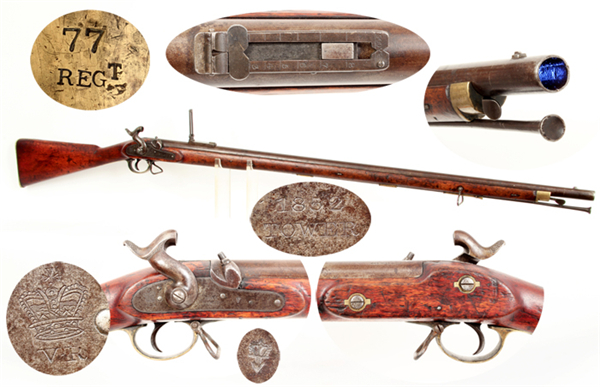
The main weapon of the Sa army is the Minerva rifle, which is loaded from the muzzle.
Sajun has two action plans: one is to contain the loyalist stationed in Kumamoto, capture the northern part of Kyushu, resist the landing of loyalist reinforcements, and observe the national situation; Second, after concentrating forces to destroy Kumamoto’s government troops, they seized Nagasaki Port, attacked Tokyo and Osaka by boat, and directly overthrew the Meiji regime.
Most Sajun officers believe that the corner of Kyushu alone cannot resist the material superiority of the central government for a long time, and most of them are from the gentry. They firmly believe that the loyalists are just weak "soldiers of farmers and businesses" and cannot confront themselves on the battlefield with real swords and spears. Therefore, Sajun chose radical option 2.

On the map of Kyushu, Japan, Sajun sent troops from Kagoshima Prefecture in the southernmost part. The most critical battle of the whole war took place in Kumamoto Prefecture in central Kyushu.
Knowing the news of Xixiang’s uprising, the Meiji government responded quickly, immediately deployed troops from various towns and stations, and temporarily organized eight brigades with a total strength of nearly 60,000 counter-insurgency troops, and appointed Prince Yukichi Miyachiren as the nominal commander-in-chief. The actual commanders were Yamagata Aritomo, Kawamura Chunyi and Kuroda Kiyotaka. The loyalist is mainly equipped with Snyder rifles with bullets at the back, and the Pisa Army has advanced weapons.

Snyder rifle widely equipped by loyalists.
On February 20, 1877, the main force of Sajun arrived in Kumamoto, and completed the encirclement of the city one day later. There are only 3,600 loyalists guarding the city. Under the command of famous officers in the future Japanese army, such as Huashan Ziji and Kodama Gentaro, relying on the fortress built by Katou Kiyomasa by the Ministry of Tokugawa Ieyasu, they fought to the death. Sajun lacked artillery to blast open loyalist bunkers, and had several times the strength advantage. The storm in kumamoto castle only advanced several tens of meters in three days. During this period, the 14th loyalist regiment rushed to reinforce, and was ambushed halfway. Sa Jun’s sword drawing team rushed out from both sides of the road, and the loyalists were cut down before they could shoot. Sa Jun pursued them and seized the flag of the loyalist regiment. The hapless commander of the 14th loyalist wing is another celebrity of the Japanese army in the future-Nogi Maresuke.

Japanese painting "Kagoshima Mob Out of the Array"
Although Sajun won a small victory in the field, the consequences of failing to conquer kumamoto castle as soon as possible were very serious. The 1st and 2nd brigades of loyalist troops had arrived in Kyushu. The Sajun’s countermeasure was to keep a small amount of troops to contain Kumamoto in the middle of Kyushu, and the main force went north to try to seize Fukuoka in the north of Kyushu.

Prepare to board the ship for the loyalist of Kyushu.
On February 25, 1877, a fierce battle broke out between the loyalist army and the Sajun army in Takase, northwest of Kumamoto. This time it was the loyalist’s turn to ambush, relying on the terrain, giving full play to the firepower advantage of Snyder’s rifle, and frequently volley. The defeated troops were divided into three roads, and even Nogi Maresuke, who suffered a big loss a few days ago, turned over. After the war of Takase, the Sajun lost the possibility of occupying Fukuoka and retreated outside kumamoto castle.
After loyalists were reinforced by two brigades, they began to clear Kumamoto. Sajun established a defense line around the Liangen hills north of Kumamoto, and used the tactics of delaying the frontal gun discharge and ambushing the flanking sword-drawing team to defeat the loyalist offensive one after another. The loyalist army struggled hard for half a month in the continuous spring rain, and made little progress, so it had to find another way. On March 18, 1877, it sent three warships to cover two brigades and landed 40 kilometers south of Kumamoto, attacking the rear of Sajun.
Two days later, the loyalist on the front of the Sajun defense launched a new round of onslaught. In order to cope with the shadowy Sajun sword-drawing team, loyalist urgently transferred the police from kanto region who were born in the cremation and proficient in fencing, and formed their own sword-drawing team. Ironically, although the loyalist sword-drawing team is a "temporary worker", there are many samurai who worked for the Tokugawa shogunate ten years ago. When they saw the Samoan samurai, the main force of the fall, they were particularly jealous when they met, and they fought harder than the real loyalist.

The Sa army’s sword drawing team and the loyalist sword drawing team fought fiercely.
Weakened the threat of the Sa army’s sword-drawing team, the main force of the loyalist army gave full play to its advantages, and frequently launched a group charge under the cover of artillery. Not to be outdone, the Sa army constantly launched a counterattack. The two sides were caught in a bitter tug-of-war, and the casualties soared. At the same time, the loyalist who landed behind the Sa army slowly and steadily approached Kumamoto.
In mid-April, 1877, the Sajun, who was caught between Scylla and Charybdis, finally couldn’t support it, lifted the siege of Kumamoto, retreated to the plain in the east of the city, was caught up by the loyalist, and was defeated again. Saigō Takamori led the army back to central Kyushu, and before he could reorganize the remnants, loyalists landed in Kagoshima County, the home of Sajun, from the sea. The Sa army, which lost its base area, became a rogue group. In the next three months, it "turned around" in the eastern part of Kyushu, getting weaker and weaker, and the whole system surrendered and even defected.

After the loyalist landed in Kagoshima Prefecture, the Sa army was losing ground.
On August 15th, 1877, the Sa army with only about 3,500 people left could not retreat, but just turned around and fought a "decisive battle" with more than 50,000 chasing loyalists. The result was self-evident, and it was quickly surrounded by loyalists. Saigō Takamori ordered that "… today, there is only a decisive battle to fight to the death, and the teams will surrender if they want to, or die if they want to …" Most of the Sa army remnants chose to surrender to loyalists, and the remaining 1,000 people swore to death.
Saigō Takamori led the thousands of dead men to break through the weak encirclement of loyalists, and in the next 14 days, they attacked 400 kilometers, and even killed their hometown of Kagoshima County, scaring the new county magistrate just appointed by the government to climb the warship and escape-but that’s all-the violent machine in modern industrial countries, even if it has just established its embryonic form, its fighting capacity is far beyond the feudal era. Saigō Takamori’s "feat" is like giving loyalists a slap in the face, and eight brigades are non-stop.
The loyalist repeatedly surrendered Saigō Takamori, who had only 350 men under his command. All of them were rejected, and they launched the final attack on September 24, 1877. Saigō Takamori was wounded by stray bullets in the battle, cut his belly, and his head was found by the loyalist who cleaned the battlefield.

Saigō Takamori died in the final siege of loyalist.
The Southwest War, which lasted for seven months, ended. More than 6,800 loyalists were killed, while more than 7,200 Sajun were killed, most of whom were gentry from the former Samoan clan.
Rise and fall: progressives are not necessarily cute.
One year after the end of the Southwest War, Ōkubo Toshimichi was assassinated by the gentry and died at the age of 49, just like Saigō Takamori.
Just as Lincoln’s assassination did not reverse the historical process of abolishing slavery in the United States, Ōkubo Toshimichi’s death did not interrupt the Meiji Restoration in Japan, and samurai, as a special class that dominated Japanese society for nearly a thousand years, completely became history. The Sa Army in the Southwest War was the last political group with samurai (gentry) as its identity.
To this day, Japanese people love Saigō Takamori far more than Ōkubo Toshimichi: Saigō Takamori is chivalrous and helps the weak, while Ōkubo Toshimichi is unkind and unscrupulous. In their hometown of Kagoshima Prefecture, the memorial to Ōkubo Toshimichi is only a lonely bronze statue in the city center, while Saigō Takamori appears on transportation, media and souvenirs in various ways …
However, to treat historical figures, we must stand at the height of history, abolish the class barrier in which samurai are in power, and clear the biggest obstacle for Japanese to develop capitalism. No matter how ruthless Ōkubo Toshimichi is, he is still a progressive reformer. Saigō Takamori, who sticks to the feudal warrior rule, can only be ruthlessly eliminated by history, no matter how brave Ren Xia is. The truth is, as Dr. Sun Yat-sen later said: "The historical trend is mighty. If you follow it, you will prosper, and if you go against it, you will die."