What impact will the RMB exchange rate "break 7" have? Understand a text
Zhongxin. com, September 17 (Zhongxin Finance reporter Xie Yiguan) After the offshore RMB fell below the 7.0 mark against the US dollar on September 15, on September 16, the onshore RMB also "broke 7" against the US dollar, which was the first time since July 2020.
What does it mean for RMB exchange rate to break 7? What impact will it bring to daily life, enterprise export and even capital market? Will the RMB continue to depreciate?
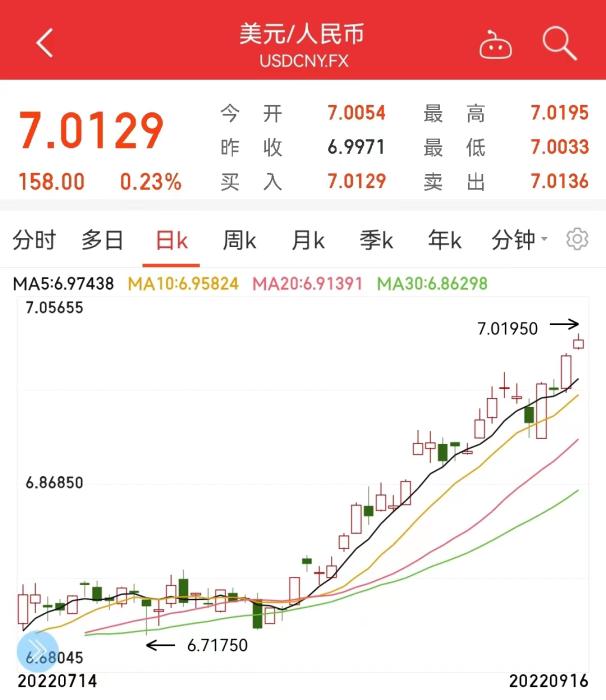
On-shore chart of RMB against USD.
The RMB exchange rate "broke 7", which is beyond the reasonable range?
When the relevant person in charge of the central bank responded to the RMB "breaking 7", he said: the RMB exchange rate "breaking 7", this "7" is not an age, and it can’t come back in the past, nor is it a dam. Once it is broken through the flood, it will plummet; "7" is more like the water level of a reservoir. It is higher in the wet season, and it will fall again in the dry season, with ups and downs.
"This staged short-term devaluation is normal, and the RMB exchange rate is a two-way fluctuation." Dong Dengxin, director of the Institute of Financial Securities of Wuhan University of Science and Technology, told reporters that the RMB exchange rate basically fluctuates around 6 to 7, and the "breaking 7" is still within a reasonable range, and the RMB exchange rate is still stable.
This "breaking 7" originated from American monetary policy?
The RMB exchange rate broke 7 again after two years. According to Wen Bin, chief economist of Minsheng Bank, it was mainly influenced by the accelerated tightening of monetary policy by the Federal Reserve to curb high inflation. With the continuous strengthening of the US dollar index, most non-US dollar currencies, including the RMB, experienced different degrees of depreciation.
Recently, the Federal Reserve has repeatedly released the signal of raising interest rates. In August, the CPI of the United States rose by 8.3% year-on-year, which exceeded market expectations, and also caused a lot of discussion on raising interest rates in the US market. Recently, the US dollar index has strengthened again.
Guojin Securities believes that under the continuous differentiation of policy interest rates between China and the United States, the yield of 10-year government bonds between China and the United States has been upside down again and widened rapidly since August 5, which has also suppressed the RMB exchange rate to some extent.
Will the lower RMB exchange rate benefit export enterprises?
In Dong Dengxin’s view, "a moderate depreciation of RMB may help to stimulate the export of domestic products. After expanding exports, it will also have a pulling effect on economic growth. "
Guojin Securities also said that the depreciation of the RMB will further enhance the price competitive advantage of some industries with relatively high exports. The overseas income of export business is also expected to benefit from exchange gains, and the depreciation of RMB may further increase the profits of export-oriented enterprises.
However, Bai Ming, deputy director of the International Market Research Institute of the Ministry of Commerce, believes that the depreciation of the RMB exchange rate is also a double-edged sword. Export enterprises have increased their income by the depreciation of RMB exchange rate, but if they use too many imported raw materials and spare parts, they are likely to increase their expenses because of the depreciation of RMB exchange rate.
Does RMB depreciation have an impact on daily life?
In the impression of many people, after the depreciation of the RMB, studying abroad and shopping in Haitao will increase costs. But if you just stay at home and buy your own goods, will it make no difference?
From a comprehensive point of view, although the depreciation of the RMB against the US dollar has a relatively small impact on the daily life and prices of ordinary people, the world is a unified big market, and the rising prices of some imported raw materials will increase the production costs of enterprises, thus affecting commodity prices. If we buy these goods, our expenses will also increase.
However, although the exchange rate of RMB against the US dollar has weakened, it has remained stable against a basket of currencies. This also means that if we go to countries with non-US dollars as the main settlement currency, we may not have to pay extra costs.
Will the depreciation of RMB against the US dollar affect the stock market?
Ping An Securities believes that both RMB exchange rate and stock price are the result of market pricing, and the correlation between them is more reflected in whether they are affected by the same factors and the cross-influence between the two markets, rather than causality.
"Among them, economic growth, liquidity and external events will all affect cross-border capital flows and the expected rate of return of financial assets. The effects of fundamentals and contingencies on exchange rates and stock markets tend to resonate synchronously, while the effects of liquidity are different. In addition, fluctuations in foreign investment behavior may amplify the fluctuations in the A-share market to some extent." Ping An Securities said.
Although many people are worried that under the depreciation of RMB, capital will flow out. However, the data of foreign exchange settlement and sale in August showed that the situation of foreign investors investing in domestic bonds and stock markets continued to improve.
Wang Chunying, deputy director and spokesperson of the State Administration of Foreign Exchange, said recently that the net inflow of cross-border funds under the trade in goods continued to be relatively large, and the inflow of foreign capital through channels such as direct investment increased steadily.
Is it a good time to buy dollars and gold?
Under the depreciation of RMB, how to allocate assets, is gold or dollar a good choice?
Dong Dengxin said that investment should have a long-term concept and should be judged from the long-term trend. "At present, the RMB exchange rate is still in a stable range, which will basically not change investors’ expectations much."
"Gold is linked to the US dollar, and the fluctuation of the gold price has a strong correlation with the fluctuation of the US dollar exchange rate. Simply put, when the dollar appreciates, gold will depreciate. " Dong Dengxin said that at present, gold is still at a high level. If the US dollar continues to appreciate, gold may depreciate sharply, so the risk of investing in gold is very great.
"In this special period, cash is king. Holding cash in hand, you can intervene at a good low point at any time and get considerable benefits. " Dong Dengxin added.
Will RMB continue to depreciate?
Wen Bin believes that from the perspective of China’s economic fundamentals, it is expected that the GDP growth rate in the third quarter will be significantly higher than that in the second quarter, the inflation level will be moderate and controllable, and the balance of payments will be in good condition, especially the basic balance of payments projects such as current account and direct investment will maintain a high surplus, laying the foundation for the stability of the RMB exchange rate and the smooth operation of the foreign exchange market. There is no basis for the continued depreciation of the RMB.
Since September 15th, the central bank has lowered the foreign exchange reserve ratio of financial institutions by 2 percentage points from 8% to 6%, which is the second reduction in this round of RMB overvaluation.
"After reviewing the operation history of this tool in recent years, it can be seen that adjusting the foreign exchange deposit reserve ratio has a good countercyclical adjustment effect." Li Yuebo, an analyst at Caitong Securities, said that if the pressure of RMB depreciation continues, the central bank’s countercyclical adjustment policy toolbox also has countercyclical adjustment factors, offshore central bank bills, forward foreign exchange sales risk reserves, and foreign exchange reserves. (End)